When I was snowboarding in Aspen, I wasn't just riding the slopes — I was paying close attention to everything around me. The people, the houses, the infrastructure. And what I saw got me thinking deeply about how extreme wealth concentration actually works.
This is the kind of place where spending $50K, $200K, or $500K on a single week of vacation is normal. Where real estate prices exist in a completely different stratosphere — homes routinely listed for tens of millions of dollars.
I started researching the price history of these properties, and what surprised me most wasn't the prices themselves — it was how consistently they've risen over the past 15 years. No meaningful corrections. No plateaus. Just up.
On the surface, it makes sense. Aspen is glamorous. It offers complete privacy. It's surrounded by mountains, so there's essentially nowhere left to build. But I kept thinking: there has to be a ceiling, right? The number of people who can afford a $30 million home can't be that large. There shouldn't be that many bidders.
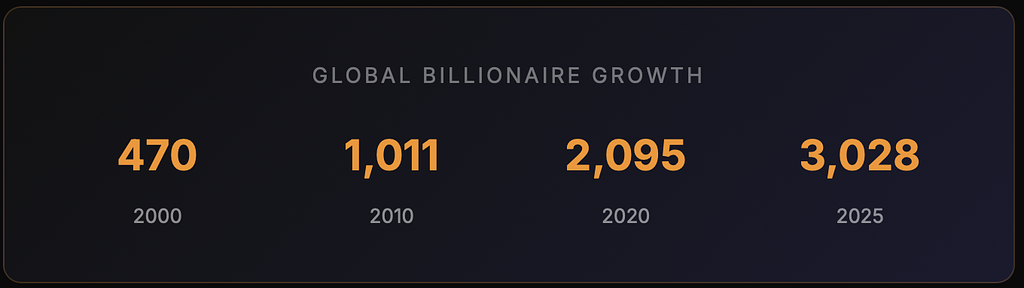
Then I looked at the data. CleanShot 2026-02-11 at 20.34.24@2x.png527 KB
A 6x increase in 25 years. And suddenly the math clicked. When supply is extremely constrained and the pool of buyers is doubling every decade, buying at what looks like an insane price today actually makes perfect sense. In 10 years, the market of people who can afford these homes will likely double — and so will the prices.
The only things that stop this game? World war. A Great Depression. A pandemic worse than the last one.
But here's where it gets interesting.
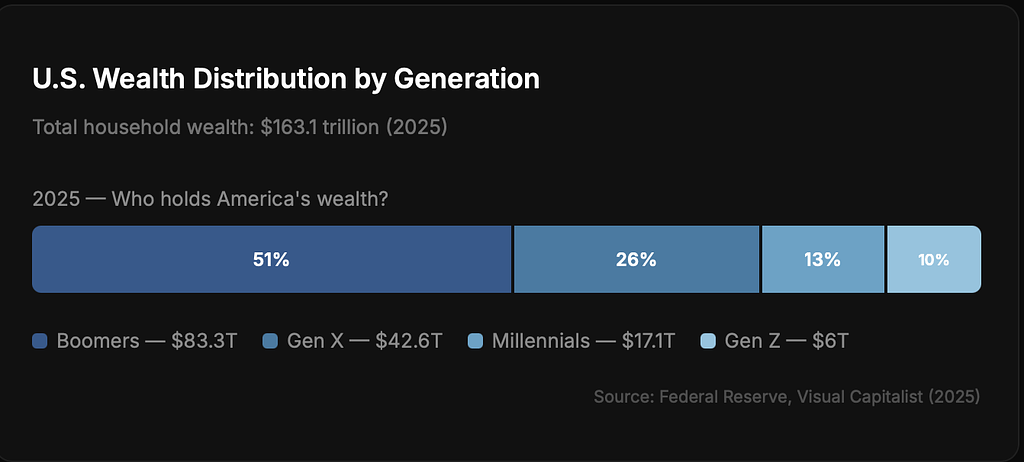
Walk around Aspen and you notice something: the average billionaire is about 65 years old. Their wealth is concentrated in traditional assets — equities, real estate, private companies. And it's not just billionaires. Look at how wealth is distributed across generations in America:
CleanShot 2026-02-11 at 20.34.54@2x.png74.9 KB
Baby Boomers — just 20% of the population — control over 51% of all wealth.Their $83.3 trillion is parked predominantly in financial assets and real estate. This is the generation buying $30 million homes in Aspen.
But what happens when this wealth starts moving? By some estimates, $124 trillion will transfer to younger generations in the coming decades — the largest wealth transfer in human history.
And here's the question no one's asking loudly enough: will the next generation park their money in the same places?
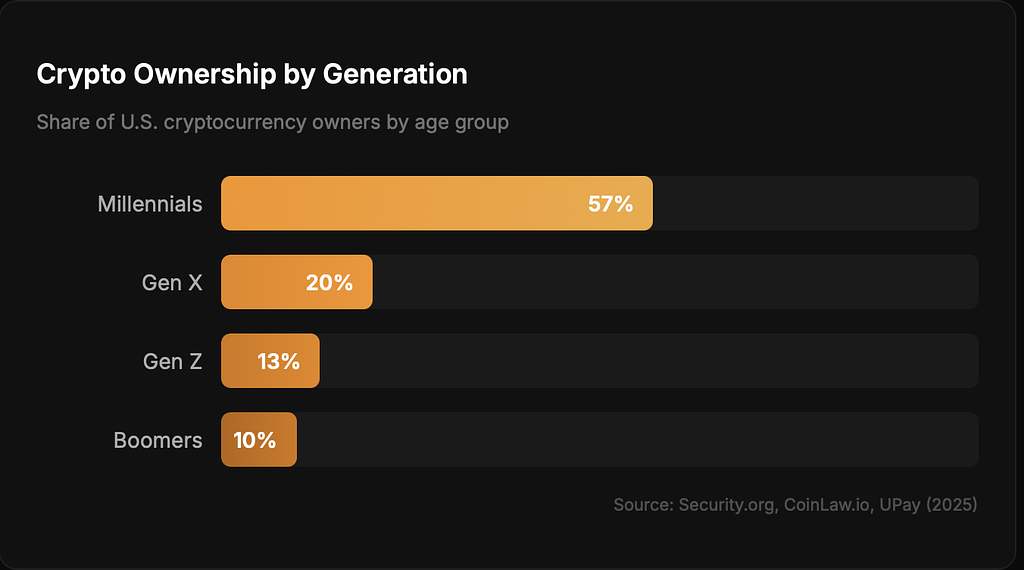
Now look at who actually owns crypto:
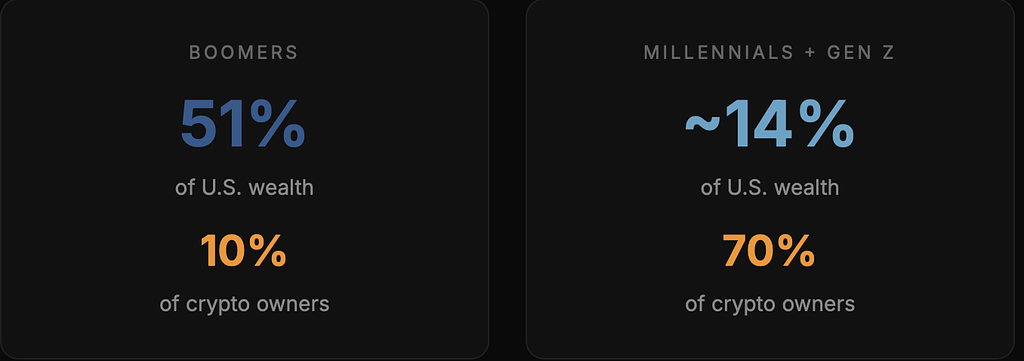
CleanShot 2026-02-11 at 20.35.18@2x.png155 KB The contrast is striking. The generation that holds 51% of America's wealth accounts for just 10% of crypto ownership. The generations building their financial identity around digital assets hold only 23% of the wealth.
CleanShot 2026-02-11 at 20.35.44@2x.png57.5 KB
These two charts tell the entire story. Right now, the people with the money don't buy crypto. And the people who buy crypto don't have the money — yet.
When $124 trillion starts flowing from a generation that trusts banks and real estate to a generation that trusts code and cryptography — something fundamental shifts.
And there's another angle that doesn't get talked about enough. On paper, if you own one of these $30 million homes, it's yours. Nobody can take it. But stop paying your property taxes and you'll quickly discover who really owns it.
You don't truly own something if someone can take it from you for not paying rent to the government.
This isn't an abstract philosophical point. It's a practical one. Baby Boomers grew up trusting institutions — government, banks, the system. That trust is reflected in where they store their wealth: real estate, equities, bonds — all instruments that exist within and depend on institutional frameworks.
Millennials and Gen Z? Not so much. They watched the 2008 financial crisis, Covid-19 etc. They've lived through inflation eroding their purchasing power. They've seen governments print money at unprecedented scales. Their default stance toward institutions is skepticism.
When you combine all of this — a generational wealth transfer unprecedented in scale, a fundamental shift in trust away from institutions, a younger generation that grew up digital-native and builds wealth through technology, AI, and crypto — Bitcoin becomes something much bigger than most people can comprehend right now.
It's not just a speculative asset. It's a generational bet on a different kind of ownership — one where no government, no bank, and no tax authority can tell you that what's yours isn't really yours.
We might not fully understand the scale of it yet. But the pieces are falling into place.